You Won’t Believe What I Found in Busan’s Underground Art Scene
When I first arrived in Busan, I expected beaches and seafood markets—but not the explosion of creativity hiding in plain sight. From converted warehouses to alleyway murals, the city’s art spaces are raw, bold, and totally unfiltered. This isn’t just gallery stuff; it’s art that breathes with the streets. If you're looking for something real, something unexpected, Busan’s creative corners will blow your mind. More than a coastal escape, this South Korean metropolis pulses with a quiet revolution—one painted in color, shaped by community, and rooted in resilience. What you find here isn’t staged for tourists. It’s lived, felt, and constantly evolving. This is urban art at its most authentic, and it’s waiting just beneath the surface.
First Glimpse: Stepping Into Busan’s Creative Pulse
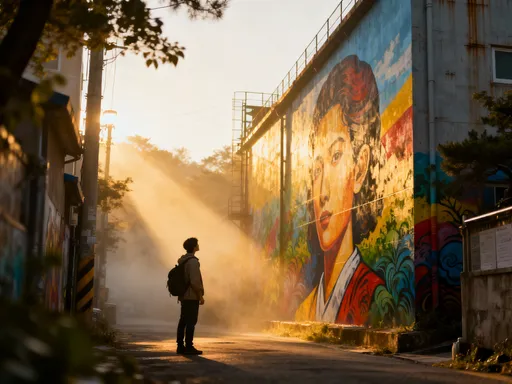
The first mural caught me off guard. I was walking through a quiet residential district near the old port, searching for a local noodle shop, when the street suddenly opened into a burst of crimson and gold. A towering wall, once dull concrete, now shimmered with a painted phoenix rising from industrial smokestacks. The image pulsed with energy—feathers rendered in sweeping brushstrokes, eyes glowing with defiance. It wasn’t just decoration; it felt like a statement. Around me, neighbors passed by without pause, as if such brilliance was ordinary. And in Busan, perhaps it is.
This is the essence of the city’s underground art movement: it doesn’t announce itself. There are no red carpets or velvet ropes. Instead, creativity spills into the everyday. A staircase becomes a canvas for cascading waves. A forgotten electrical box blooms with wildflowers. These moments of surprise redefine what a city can feel like. For visitors, the experience is deeply personal—less about ticking off landmarks, more about stumbling upon beauty where you least expect it.
What makes this pulse so powerful is its authenticity. Unlike curated museum exhibits, Busan’s street art grows organically from the city’s history. Once a hub for shipbuilding and manufacturing, the city carries the scars and strengths of its industrial past. Now, artists channel that legacy into visual storytelling. Rust and steel are no longer signs of decline—they’re sources of inspiration. The contrast between expectation and reality couldn’t be starker. Most travelers come for the sea, but many leave transformed by the soul they discovered in the streets.
The Rise of Reimagined Spaces: From Factories to Galleries
One of the most striking features of Busan’s art evolution is how it repurposes the forgotten. Across the city, abandoned factories, disused warehouses, and decommissioned rail yards have been reclaimed as vibrant cultural spaces. These transformations are not acts of erasure, but of dialogue—between past and present, utility and beauty, decay and rebirth. Where machines once roared, silence now holds space for contemplation. Where workers once clocked in, visitors now wander through galleries lit by natural light filtering through broken skylights.
This shift didn’t happen overnight. It emerged from a growing recognition that culture can be both a catalyst and a comfort. Local government programs began supporting urban renewal through the arts, offering grants and low-cost leases to artist collectives willing to occupy and revitalize neglected buildings. At the same time, grassroots movements took root. Independent creators, frustrated by the high costs of traditional galleries, banded together to create shared studios and exhibition zones. The result? A network of creative hubs that are as diverse as they are accessible.
Take, for example, a former textile mill in the Sasang district. Once slated for demolition, it now hosts rotating installations, performance art, and community workshops. The original brick walls remain, their weathered surfaces adding texture to contemporary pieces. Visitors walk past loom-shaped sculptures made from reclaimed metal, or pause in a courtyard where wind chimes crafted from old tools sing in the breeze. These spaces are not sanitized; they retain the grit that gives them character. And that authenticity is precisely what draws people in.
Importantly, this transformation also carries environmental and social weight. By reusing existing structures, the city reduces construction waste and preserves architectural history. More subtly, it fosters a sense of ownership among residents. When art moves into neighborhoods, it doesn’t displace communities—it becomes part of them. Children grow up seeing creativity as a normal part of life. Elders share stories with artists who incorporate local history into their work. In this way, repurposed spaces do more than display art—they build bridges.
Street Art That Speaks: Murals With a Message
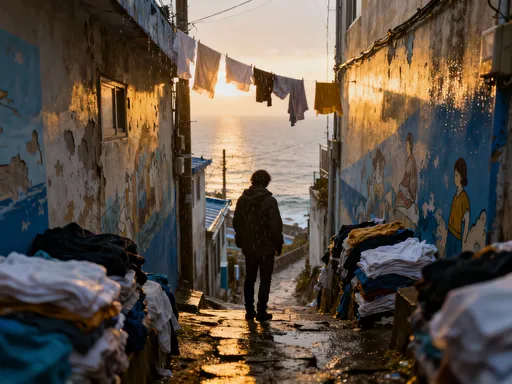
Busan’s murals are not just visually arresting—they are deeply communicative. Each wall tells a story, whether it’s a whimsical tale of a cat sailing the seas or a solemn reflection on the passage of time. In the Geumjeong district, one long alley is entirely covered in a single narrative: a journey from childhood to old age, rendered in soft pastels and sharp ink lines. A child chases a balloon shaped like the moon. Further down, an elderly couple sits on a bench, their silhouettes blending into a fading sunset. Passersby often stop, not just to take photos, but to stand quietly, as if remembering their own lives.
What sets Busan’s street art apart is its emotional intelligence. These are not random splashes of paint. They are deliberate acts of public conversation. Artists use their work to explore identity, memory, and the rhythm of urban life. In the Suyeong area, a series of murals depict fishermen and women in traditional dress, their faces strong and serene. The images honor the city’s maritime roots while questioning what gets lost in modernization. Nearby, another wall shows a child holding a smartphone, their face illuminated by its cold glow—while behind them, a painted sea turtle swims into darkness. The contrast speaks volumes about generational change and environmental awareness.
Sensory details bring these messages to life. The paint is often layered—thick impasto strokes next to delicate spray gradients. Some artists embed materials like fabric or wire into the surface, creating texture that invites touch. In the early morning, when the sun hits at a low angle, shadows dance across the walls, making the art feel alive. Locals sometimes leave small offerings—flowers, handwritten notes, or origami birds—near their favorite pieces, turning public art into a living ritual.
Even humor plays a role. In a narrow lane behind a traditional market, a mural shows a squid juggling fish cakes, with a speech bubble that reads, “I’m not just food!” Laughter ripples through the crowd whenever someone new discovers it. Yet beneath the playfulness is a subtle pride—a celebration of local culture, of resilience, of joy found in the ordinary. Busan’s street art doesn’t shout. It whispers, laughs, mourns, and sings—and if you listen, it might just speak to you.
Hidden Courtyards and Secret Studios: Off-the-Beaten-Path Gems
While the murals grab attention, some of Busan’s most enchanting art exists in silence—in tucked-away courtyards, behind unmarked doors, above narrow staircases. These are the city’s best-kept secrets, known more to locals than to guidebooks. One afternoon, following a tip from a tea vendor, I ducked behind a 60-year-old hanok-style house and found a hidden sculpture garden. Stone carvings of cranes stood among moss-covered lanterns. A koi pond reflected a kinetic wind sculpture that turned gently in the breeze, its metal petals chiming like distant bells. No signs, no entry fee—just peace and beauty, offered freely.
These intimate spaces thrive on discovery. A former tailor shop in the Dongnae district now hosts rotating pop-up exhibitions. The sewing machines are gone, but the wooden counters remain, now displaying small ceramic works or hand-bound sketchbooks. Artists use the space for a week or two at a time, often living on-site to interact with visitors. I met a printmaker there who had spent years documenting vanishing alley markets. Her black-and-white linocuts captured the wrinkled hands of vendors, the stacked baskets of persimmons, the quiet dignity of daily labor. She spoke softly, almost shyly, but her work roared with respect.
What makes these hidden studios so powerful is their lack of pretense. There’s no curator’s statement on the wall, no price list, no pressure to perform. You’re not entering a temple of art—you’re stepping into someone’s creative sanctuary. That intimacy fosters connection. I watched a grandmother sit with her granddaughter in a sunlit back room, tracing the lines of a charcoal drawing of a mountain. “This is how our ancestors saw the world,” she said. In moments like these, art becomes education, memory, love.
Exploring these spaces requires slowing down. You won’t find them on standard maps. Instead, you need to wander, to notice the small details: a paint-splattered doorway, a flyer taped to a lamppost, a faint melody drifting from an upper window. But the reward is worth it. These are not just art venues—they are acts of trust, invitations to see the city through the eyes of those who live here. And in a world that often feels rushed and impersonal, that kind of connection is rare and precious.
Art Meets Ocean: Coastal Creativity With a View
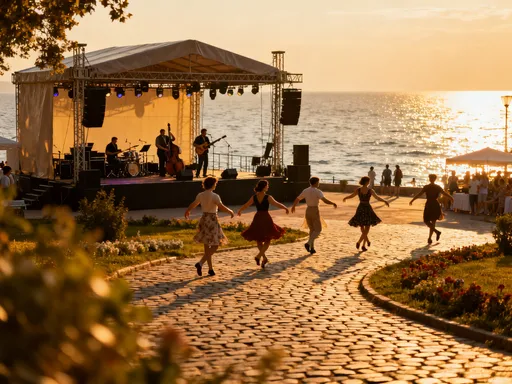
Busan’s relationship with the sea is not just geographical—it’s artistic, emotional, spiritual. Along the coastline, particularly near Haeundae and Gwangalli, a unique form of art has emerged: installations that interact with tides, light, and wind. These are not static objects. They change with the hour, the season, the mood of the water. One striking example is a series of mirrored pillars installed on a rocky outcrop. At sunrise, they reflect the pink sky. At high tide, the sea laps around them, turning the reflection into a shimmering mosaic. At night, embedded LEDs glow like underwater stars.
The ocean’s influence runs deep in Busan’s creative identity. Many artists draw inspiration from its rhythms—its constancy, its unpredictability, its power. Sculptures often mimic wave forms, using curved steel or flowing ceramic. Paintings feature layered blues and greens, applied in sweeping motions that echo the motion of water. Even performance art finds its home here: I once witnessed a silent dance piece on the beach at dawn, where performers moved like kelp swaying in the current, their costumes dyed with natural pigments from seaweed.
What makes coastal art so compelling is its impermanence. Some installations are designed to erode, to be reclaimed by the sea. A sand sculpture festival, held annually, invites artists to build intricate castles and figures that will vanish with the next tide. There’s a quiet philosophy in this—beauty doesn’t have to last to matter. In fact, its fleeting nature makes it more precious. Visitors often stand at the water’s edge, watching the waves take back a sculpture, and there’s a shared stillness, a collective breath.
This dialogue between nature and creativity extends to community projects as well. Local schools collaborate with artists to create tide-responsive murals on seawalls—images that appear only when the water recedes. Fishermen contribute stories that become part of sound installations played through hidden speakers along the promenade. Even the scent of salt and seaweed becomes part of the experience. In these moments, art doesn’t imitate life—it becomes part of the environment, inseparable from the place that shaped it.
Connecting With Makers: Artist Talks and Workshop Culture
One of the most heartening trends in Busan’s art scene is the growing emphasis on connection. More than ever, artists are opening their doors—literally and figuratively—to share their process, their inspirations, and their lives. Open studio days have become common, especially in the spring and autumn months. During these events, visitors can walk into working spaces, watch artists at their easels or kilns, and ask questions without formality. I once spent an afternoon with a ceramicist who demonstrated how she mixes local clay with crushed seashells to create a unique texture. As she shaped a bowl on the wheel, she spoke about her grandmother, who once gathered shellfish along this same coast.
Workshops have also flourished, offering hands-on experiences for travelers of all ages. From block printing to natural dyeing, from mural sketching to recycled sculpture, these sessions are designed to be accessible, not intimidating. No prior skill is required—just curiosity. I joined a family-friendly workshop where we painted small wooden tiles with symbols of protection and hope, then added them to a growing community wall. By the end of the day, the wall was a kaleidoscope of colors and messages, each piece a tiny act of faith in the future.
Language is never a barrier. Many studios offer multilingual guides or use visual demonstrations to bridge gaps. Some artists partner with local cafes to host informal talks over tea, where conversation flows as easily as the drink. These moments matter. They transform art from something to observe into something to participate in. For older visitors, especially, these interactions can be deeply moving—a chance to create, to connect, to feel relevant. One woman in her sixties told me, tears in her eyes, “I haven’t made anything with my hands in thirty years. Today, I feel alive again.”
These programs also support sustainability. Fees from workshops often go directly to the artists or fund community projects. Some studios offer free sessions for local youth, ensuring that creativity remains inclusive. In a world where art can feel exclusive or commercial, Busan’s maker culture reminds us that creativity belongs to everyone. It’s not about perfection. It’s about presence.
How to Explore Like a Local: Practical Tips for Art-Focused Travelers
To truly experience Busan’s underground art scene, it helps to travel like a resident, not a checklist tourist. Start by slowing down. The best discoveries happen on foot, in neighborhoods like Seomyeon, Beomil, and Jwacheon, where art blends seamlessly into daily life. Plan a walking route that includes both known spots and open-ended exploration. Begin at a cultural complex, then let your curiosity guide you down side streets and alleyways. Carry a small notebook to sketch or jot down impressions—many artists appreciate the gesture.
Timing matters. Mornings are ideal for photography, when light falls gently on murals and foot traffic is light. Weekdays offer quieter access to studios and workshops. If you visit in spring or autumn, check local event calendars for art festivals, open studio weekends, or pop-up exhibitions. These times bring extra energy and opportunities for interaction. Avoid peak summer weekends at coastal installations, when Haeundae Beach draws large crowds.
Transportation is easy. Busan’s subway and bus system are efficient and well-marked in English. The Busan City Tour Bus also includes stops at major cultural sites, though the real gems often require a short walk off the main path. Consider renting a bicycle—many neighborhoods are bike-friendly, and it allows you to cover more ground while staying alert to hidden details.
When engaging with art, practice respectful curiosity. Don’t touch installations unless invited. Ask permission before photographing artists at work. Support creators by purchasing small works or workshop tickets—many studios accept international cards. And always pair your art visits with local life: stop at a street food cart for hot tteokbokki, sip barley tea at a neighborhood café, or rest on a bench and watch the world pass by. These moments of pause deepen the experience, grounding the art in the rhythm of the city.
Conclusion
Busan’s art spaces aren’t just places to see—they’re invitations to feel, question, and connect. In a world of cookie-cutter destinations, this city proves that true creativity thrives where history, heart, and hustle meet. The real magic? You don’t need to be an art expert—just curious. So next time you travel, let your feet follow the paint splashes. Who knows what you’ll discover? Whether it’s a mural that mirrors your own memories, a quiet courtyard that offers peace, or a conversation with an artist that shifts your perspective, Busan reminds us that beauty lives in the unexpected. And sometimes, all it takes is a single step off the main road to find it.