Lost in Busan’s Hidden Urban Corners—And Loving Every Minute
You know that feeling when a city surprises you? Busan didn’t just surprise me—it completely rewired how I see urban travel. Forget the postcard spots; the real magic lies in its quiet alleys, forgotten underpasses, and seaside neighborhoods no tourist map shows. This is urban space reimagined: raw, real, and refreshingly untouched. If you're craving authenticity over crowds, stick around—this journey’s for you. Busan, South Korea’s second-largest city, is often celebrated for its beaches, temples, and bustling markets. But beyond these well-trodden paths, a quieter, more intimate version of the city pulses beneath the surface. It reveals itself not in grand gestures, but in the soft hum of laundry flapping above narrow lanes, the scent of grilled mackerel drifting from a hidden alleyway kitchen, or the unexpected splash of color on a concrete wall deep beneath an overpass. This is not a city that shouts. It whispers. And if you slow down enough to listen, Busan offers a rare kind of urban intimacy—one built not on spectacle, but on presence.
Rewriting the Urban Script: Why Busan’s Hidden Spaces Matter
Most travelers experience cities through curated itineraries: the top five sights, the best rooftop bars, the must-try street food stalls. Yet, in places like Busan, the essence of urban life often resides far from these polished touchpoints. The city’s soul is embedded in its overlooked corners—where cracked pavement meets salt-kissed air, where elderly women sit on low stools outside their homes peeling garlic, and where children weave bicycles through alleys too narrow for cars. These are not flaws in the city’s design; they are features. They reflect a kind of organic urbanism that evolves not from master plans, but from generations of lived experience. In a world increasingly dominated by homogenized cityscapes—glass towers, chain stores, and algorithm-driven tourism—Busan’s unpolished edges offer a refreshing alternative. They remind us that cities are not just infrastructures, but ecosystems of human connection, memory, and adaptation.
What makes these spaces significant is not their aesthetic alone, but their authenticity. Unlike tourist zones designed for consumption, these areas exist for the people who live in them. A narrow passageway between two homes may serve as a shortcut for a grandmother carrying groceries, a gathering spot for neighbors exchanging news, or a shaded path where cats nap during the afternoon heat. Each function adds layers of meaning. Urban theorists often speak of "third places"—spaces beyond home and work where community forms. In Busan, these third places are not always cafes or parks. They are staircases worn smooth by decades of footsteps, benches tucked beneath stairwells, or the open doorway of a tiny hardware shop where the owner knows every customer by name. These are the quiet engines of social cohesion, invisible to most visitors but vital to the city’s rhythm.
Moreover, these hidden spaces often reveal the city’s resilience. Busan, shaped by postwar reconstruction, rapid industrialization, and coastal geography, has grown in fits and starts. Its urban fabric is patchwork: modern apartments sit beside traditional tile-roofed houses; shipping containers double as pop-up cafes; and vacant lots bloom into temporary gardens. This improvisational character is not a sign of neglect, but of adaptability. When official infrastructure lags, residents fill the gaps. A community paints murals on a dull retaining wall. A retired fisherman turns his shed into a tiny museum of local maritime history. These acts of quiet stewardship keep neighborhoods alive, even as economic pressures and development plans loom. To walk through these areas is to witness urban life not as a fixed entity, but as an ongoing conversation between people and place.
The Pulse of Gamcheon Culture Village—But Beyond the Murals
Ask any traveler about Busan, and Gamcheon Culture Village is likely to come up. Known for its rainbow-colored houses stacked along steep hillsides, it has become one of the city’s most photographed destinations. What began as a modest hillside settlement for refugees in the 1950s was transformed in the 2010s through a public art initiative that painted homes in vibrant hues and added whimsical sculptures. Today, it draws thousands of visitors annually, many following marked trails and snapping selfies beside giant cat statues. While the murals are undeniably charming, the true heartbeat of Gamcheon lies beyond the postcard-perfect facades.
Wander just a few steps off the main path, and the tourist energy fades. Here, narrow staircases—some little more than concrete slabs wedged into the hillside—become the neighborhood’s circulatory system. Residents, many of them elderly, move effortlessly between levels, carrying bags of rice, watering rooftop plants, or pausing to chat with neighbors. These stairways are more than just access routes; they are social connectors. An old man sits on a step with a cup of barley tea, greeting passersby. A woman hangs laundry on a line strung between buildings, her radio playing trot music from the 1970s. These moments are unscripted, unhurried, and deeply human. They reflect a way of life shaped by vertical living, where proximity fosters familiarity and daily routines unfold in full view of the community.
Equally revealing are the small workshops tucked between homes—woodworking sheds, repair shops, and studios where artisans craft traditional items. One such space, barely wider than a closet, belongs to a retired schoolteacher who now paints miniature scenes of Busan’s old neighborhoods. He welcomes curious visitors but makes no effort to sell. For him, the work is a form of memory-keeping. Another resident runs a tiny café from her living room, serving homemade rice cakes to neighbors and the occasional lost tourist. These micro-enterprises are not designed for Instagram. They exist because they serve a need, because they bring joy, or because they keep a skill alive. They represent a quiet resistance to the commercialization that often follows tourism.
Yet, the balance is delicate. As visitor numbers rise, so do concerns about gentrification. Some long-time residents have moved out, replaced by souvenir shops and themed cafés catering to tourists. The challenge now is to preserve Gamcheon’s soul while managing its popularity. The answer may lie in community-led stewardship—ensuring that development benefits those who have lived there for decades, not just outside investors. When travelers venture beyond the murals and engage respectfully with daily life, they become part of this preservation, not its disruption.
Nampo’s Backstreets: Where Tradition Meets Quiet Rebellion
Just a short walk from Jagalchi Market, one of Korea’s largest seafood markets, lies a different side of Nampo-dong. While the market buzzes with energy—vendors shouting, tourists sampling raw octopus, and seagulls circling overhead—the surrounding alleys tell a quieter story. Here, between the neon signs and crowded sidewalks, remnants of old Busan still stand. A few hanok-style houses, their wooden beams weathered but intact, peek out from behind newer buildings. A traditional herbal medicine shop displays glass jars of dried roots and berries in its window. These fragments of the past are easy to miss, but they anchor the neighborhood in history.
What makes Nampo’s backstreets truly special, however, is the quiet renaissance led by young creatives. In basement spaces, former storage rooms, and repurposed storefronts, a new generation is reimagining urban life. A former textile warehouse now houses a micro-bookstore specializing in indie publications and zines. A shipping container, once used for port cargo, has been transformed into a minimalist coffee stand serving single-origin brews. These projects are small in scale but significant in impact. They do not erase the neighborhood’s character; instead, they layer new meanings onto it. The bookshop owner, a former teacher, hosts poetry readings and art exhibits that draw both locals and curious visitors. The barista at the coffee stand learned his craft in Melbourne and now sources beans from small Korean farms, creating a bridge between global trends and local values.
Other spaces reflect a blend of nostalgia and innovation. An old-school barber shop, unchanged for decades, still operates with vintage leather chairs and a rotary phone. The barber, in his seventies, has cut hair for three generations of the same family. Next door, a young artist runs a tiny gallery showcasing abstract paintings inspired by the sea. They are not competitors. They are neighbors, each contributing to the neighborhood’s texture. This coexistence—of tradition and experimentation, of age and youth—is what gives Nampo’s backstreets their depth. It is urban evolution at human scale, driven not by developers, but by individuals who care about place.
For travelers, exploring these lanes offers a rare kind of discovery. There are no crowds, no entry fees, no guided tours. Just the chance to wander, observe, and stumble upon something unexpected. A hand-painted sign leads to a hidden courtyard where a sculpture made of fishing nets catches the light. A narrow staircase descends to a basement jazz bar where a saxophonist plays softly on weekend nights. These experiences cannot be scheduled. They emerge from slowness, from attention, from the willingness to get slightly lost. And in that loss, there is richness.
The Secret Life of Busan’s Underpasses
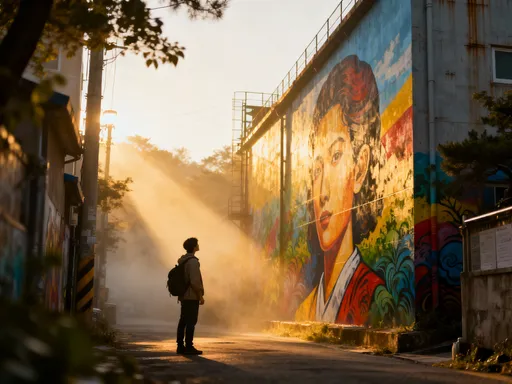
In most cities, underpasses are places to avoid—dark, damp, and often unwelcoming. They are designed for function, not experience, serving as transitional spaces between destinations. But in Busan, some underpasses have undergone a quiet transformation. Through a combination of municipal investment and community initiative, these once-overlooked spaces have become pockets of culture and connection. One near Seomyeon, the city’s bustling commercial hub, is now lined with ambient LED lighting that shifts from cool blue to warm amber as the day progresses. Local artists have painted murals on the walls—scenes of marine life, abstract patterns, and messages of hope in Korean and English. At any given time, you might find commuters pausing to take photos, students sketching in notebooks, or a street musician playing a guitar in a designated performance zone.
What makes these spaces powerful is their accessibility. Unlike museums or concert halls, they require no ticket, no dress code, no prior arrangement. They are open to everyone, at all hours. A mother pushing a stroller stops to watch a teenage dancer practice near a wall of graffiti. A delivery driver rests on a bench, listening to a folk singer strum a tune about the sea. These moments of spontaneous engagement would be unlikely in more formal settings. The underpass, once a place of avoidance, has become a stage for everyday life. It is a reminder that public space does not need to be grand to be meaningful. Sometimes, all it takes is light, color, and a little care.
The transformation did not happen overnight. It began with a city-led initiative to improve safety and aesthetics, but quickly evolved as local artists and residents got involved. In some cases, community groups organized clean-up days, then petitioned for art installations. In others, musicians began performing informally, drawing small audiences that eventually prompted the city to install proper acoustics and seating. This bottom-up collaboration has created a model for urban renewal that prioritizes people over profit. The underpasses are not sanitized or commercialized. They retain a raw edge—the concrete walls still show traces of age, the sounds of traffic hum in the background—but they feel alive in a way they never did before.
For the observant traveler, these spaces offer a lesson in urban perception. They challenge the assumption that beauty and culture belong only in designated zones. Instead, they suggest that meaning can emerge anywhere, even in the shadows beneath a highway. To walk through one of these underpasses is to experience the city not as a collection of landmarks, but as a living, breathing entity—constantly shifting, adapting, and surprising.
Coastal Fringe Living: From Haeundae’s Shadow to Gijang’s Edge
Haeundae Beach is Busan’s postcard—wide, golden, and perpetually crowded in summer. But just a short distance east, beyond the high-rise hotels and souvenir shops, the coastline changes. The urban fabric thins, giving way to quieter residential pockets where fishing culture and modern life coexist. This stretch, leading toward the town of Gijang, is where the city meets the sea in its most unfiltered form. Here, laundry hangs from balconies overlooking tide pools. Children play on rocks at low tide, searching for crabs and sea snails. Small cafes, often run by fishermen’s families, serve hot barley tea and grilled fish to a handful of regulars.
Walking through these neighborhoods feels like stepping into a different rhythm. The pace is slower, shaped by the tides rather than the clock. Fishing boats bob in small coves, their nets drying in the sun. Men in rubber boots mend gear on wooden docks. Women sort shellfish on plastic tarps, their hands moving with practiced ease. These are not performances for tourists. They are daily routines, passed down through generations. Yet, modernity is present too—Wi-Fi signs in café windows, electric scooters parked outside homes, teenagers taking selfies on rocky outcrops. The blend is not jarring; it feels organic, as if the community has chosen what to embrace and what to preserve.
One particularly striking feature is the way homes are built into the landscape. Houses cling to rocky slopes, connected by narrow staircases and winding paths. Some are modest, with corrugated metal roofs and laundry lines strung between poles. Others are more elaborate, with rooftop terraces offering panoramic sea views. What unites them is a deep connection to the water. Residents speak of the sea not as a backdrop, but as a presence—a source of food, livelihood, and identity. In the early morning, you might see an elderly couple walking the shoreline, collecting seaweed for dinner. At dusk, families gather on rocks to watch the sunset, sharing simple meals from woven baskets.
For travelers, this area offers a rare kind of immersion. There are no guided tours, no information boards, no souvenir stalls. Just the chance to walk, observe, and absorb. A local-run guesthouse might offer a room with a sea view and a homemade breakfast of fermented soybean soup and kimchi pancakes. A small community center hosts pottery workshops using clay from the nearby coast. These experiences are not marketed heavily. They are shared through word of mouth, through the quiet hospitality of people who value connection over commerce. To visit here is not to consume a destination, but to participate, however briefly, in a way of life.
Rooftop Realities: The Skyline Most Never See
Most city views are sold—rooftop bars, observation decks, ticketed elevators. But in Busan, some of the best panoramas are free, hidden in plain sight. Older commercial buildings, low-rise apartment blocks, and even abandoned structures occasionally offer access to rooftops that few tourists ever reach. These spaces are not officially designated viewpoints. They are discovered through local knowledge, curiosity, and a bit of luck. A friendly shop owner might point you to a stairwell behind his store. A neighbor might nod toward a fire escape as you wander the block. These invitations are subtle, unspoken, but meaningful.
From these vantage points, the city reveals itself in layers. To the west, the port sprawls, a maze of cranes and cargo ships. To the south, the sea glimmers under the sun, dotted with fishing boats and ferries. In the distance, mountains rise like green sentinels, framing the urban expanse. But what makes these views powerful is not just the scenery—it’s the silence. Without the buzz of crowds or the clink of cocktail glasses, you can hear the wind, the distant cry of gulls, the low hum of the city below. It is a rare moment of stillness in an otherwise busy environment.
These rooftops serve many purposes. Photographers come at golden hour to capture the city in soft light. Students bring books to study in the open air. Couples share quiet conversations as the sun sets. Some are adorned with potted plants, solar panels, or makeshift drying racks—signs of practical use. Others are bare, concrete expanses, valued simply for their openness. What they all share is a sense of escape. They are spaces of reflection, of pause, of reconnection. In a world that often feels rushed and fragmented, they offer a simple gift: perspective.
Accessing these spaces requires respect. They are not attractions. They are part of people’s daily lives. Climbing onto a private rooftop without permission is not only inappropriate—it can be dangerous. The best approach is to engage with the community, to show genuine interest, and to follow local cues. A smile, a polite question, a willingness to listen—these small acts can open doors, literally and figuratively. And when you do find one of these hidden lookouts, the reward is not just the view, but the sense of having been let in, however briefly, on a secret the city keeps close.
How to Move Like a Local: Practical Ways to Discover These Spaces
Discovering Busan’s hidden corners is not about following a checklist. It is about shifting your mindset. Slow down. Walk more. Ride less. Buses and subways are efficient, but they move you quickly from point to point, often underground or behind glass. Walking, on the other hand, allows you to notice—the crack in the pavement where a flower grows, the smell of perilla leaves frying in a back-alley kitchen, the sound of a radio drifting from an open window. It invites serendipity. Some of the most memorable moments in travel come not from planned stops, but from getting slightly lost.
Engage with people, but mindfully. A simple greeting in Korean—"Annyeonghaseyo"—can open a conversation. Ask a shop owner for a recommendation. Not "Where should I go?" but "Where do you like to eat?" The answer will likely lead you somewhere real. Be respectful of private spaces. Just because a door is open does not mean you should enter. Observe, but do not intrude. Take photos, but ask first when people are involved. These are not just rules of etiquette; they are acts of care for the communities that welcome you.
Timing matters. Visit neighborhoods early in the morning, when residents are starting their day, or in the late evening, when the pace slows. These hours offer a glimpse into daily life—grandmothers sweeping doorsteps, fishermen returning with their catch, children playing before bedtime. Avoid peak tourist times if you seek authenticity. And always, carry a sense of humility. You are a guest in someone else’s home. Your presence has impact. Choose to be a quiet, thoughtful one.
Finally, embrace uncertainty. Not every alley will lead to a revelation. Some paths end in dead ends. Some doors remain closed. And that’s okay. The goal is not to see everything, but to see deeply. To notice the way light hits a wet wall after rain. To remember the sound of a grandmother humming as she gardens. To carry not just photos, but feelings. In doing so, you don’t just visit a city. You connect with it.
Busan Taught Me to See Cities Differently
Travel is often sold as a checklist: landmarks to conquer, photos to collect, experiences to curate. But Busan reminded me that the most meaningful journeys are not about accumulation. They are about attention. The city’s hidden corners—its stairways, underpasses, rooftops, and coastal lanes—taught me to listen. To slow down. To notice the quiet stories that unfold between the noise. They showed me that authenticity is not a destination. It is a way of moving through the world.
In a time when so many places feel sanitized for tourism, Busan stands out for its willingness to remain imperfect, to let its edges show. It does not hide its cracks. It paints them. It does not erase its past. It layers new meaning onto it. And in doing so, it invites travelers not to consume, but to participate—to become temporary stewards of its stories.
So the next time you visit a city, resist the urge to rush. Step off the main path. Talk to someone. Sit on a bench and just watch. You might not find a famous landmark. But you might find something better: a moment of connection, a flash of beauty, a memory that stays with you not because it was planned, but because it was real. In the end, that is the greatest gift a city can offer—not perfection, but presence. And Busan, in its quiet, unassuming way, gives it freely.