You Gotta See These Lahore Landmarks Behind the Wheel
Driving through Lahore feels like flipping through pages of a living history book. Every turn reveals towering minarets, colonial facades, and Mughal grandeur glowing in the golden light. I hit the road with no rush—just my playlist, an open map, and a hunger for stories written in stone. From the thunderous Badshahi Mosque to the quiet elegance of Lahore Fort, exploring these landmark buildings by self-drive adds freedom and depth you just can’t get on a tour bus. The ability to pause, reflect, and proceed on your own terms transforms a simple sightseeing trip into a deeply personal journey through time, culture, and architectural brilliance.
Why Self-Driving in Lahore Elevates Your Experience
Exploring Lahore from behind the wheel offers a unique blend of independence and intimacy with the city. Unlike guided tours that follow rigid itineraries, self-driving allows travelers to set their own pace, linger at sites that resonate most, and make spontaneous detours when curiosity strikes. There’s a certain joy in navigating quiet lanes just after sunrise or pulling over to admire a fading colonial balcony without worrying about missing the next scheduled stop. This autonomy turns sightseeing into storytelling—one where you’re both the traveler and the narrator.
One of the most significant advantages of driving yourself is the flexibility it provides in timing. Major landmarks like the Badshahi Mosque or Minar-e-Pakistan can become crowded, especially on weekends and public holidays. By driving independently, visitors can arrive early in the morning, often before official opening hours, to experience these places in near-silence, with golden light washing over ancient stone. This quiet moment—when the city is still waking—offers a spiritual dimension to sightseeing that group tours rarely afford.
Modern navigation tools have made self-driving in Lahore more accessible than ever. GPS applications like Google Maps are reliable in urban areas, offering real-time traffic updates and alternative routes during peak congestion. Landmarks are clearly marked, and many tourist sites have designated parking zones nearby. While traffic in Lahore can be intense, particularly around commercial hubs like Anarkali or Mozang, the road network connecting major historical sites is well-maintained and signposted, making it manageable even for first-time drivers in the city.
Parking availability is another practical benefit of self-drive tourism. Most major monuments offer either on-site or adjacent parking facilities. For instance, near the Badshahi Mosque, several guarded lots accommodate private vehicles for a nominal fee. These areas are generally safe and monitored by local attendants, providing peace of mind while exploring on foot. Drivers should carry small change for parking fees and be prepared for informal but friendly attendants who may assist with guidance.
Beyond logistics, there’s an emotional reward in navigating Lahore’s streets personally. Each turn becomes a discovery—not just of monuments, but of everyday life unfolding around them. You might catch a glimpse of artisans repairing wooden shutters in a 19th-century haveli, or smell fresh jalebi frying near a centuries-old gateway. These unplanned moments, made possible by the freedom of self-driving, enrich the travel experience far beyond what any curated itinerary can offer.
The Iconic Badshahi Mosque: A Grand Welcome
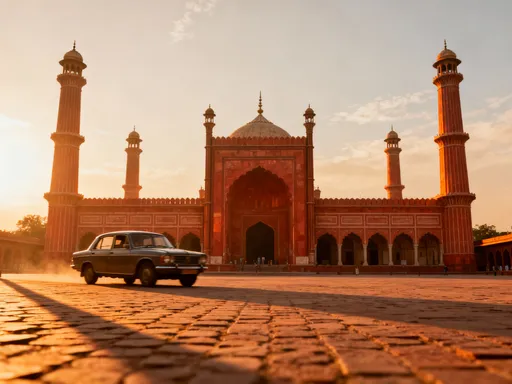
No visit to Lahore is complete without standing beneath the colossal arches of the Badshahi Mosque. Built in 1673 under Emperor Aurangzeb, this Mughal masterpiece remains one of the largest mosques in the world. Its red sandstone exterior, accented with white marble domes, glows with warmth in the morning sun, casting long shadows across its vast courtyard. The sheer scale of the structure—capable of holding 100,000 worshippers—evokes awe, not just for its size but for the precision and artistry embedded in every carved panel and arched gateway.
Approaching the mosque by car enhances the dramatic reveal. As you round the corner from the Lahore Fort, the full façade emerges gradually, framed by trees and city life. This slow unveiling—unlike the abrupt arrival common in group tours—builds anticipation and reverence. For drivers, the best access route is via Shah Alam Road, which leads directly to the northern entrance. This approach avoids the densest bazaar traffic and provides clear signage well in advance.
Parking near the Badshahi Mosque is convenient and well-organized. Several designated lots lie within a five-minute walk of the main gate, including one just off Tipu Sultan Road. These areas are typically staffed, and attendants help direct vehicles efficiently. It’s advisable to arrive before 8 a.m. to avoid crowds, especially during religious festivals or school holidays when large groups arrive mid-morning. Early access also means cooler temperatures and softer light, ideal for photography.
Visitors should be mindful of cultural norms when entering the mosque. While non-Muslims are welcome, modest clothing is required—shoulders and knees must be covered, and shoes must be removed before stepping onto the prayer hall’s marble floors. Scarves are available for rent near the entrance, but bringing your own is recommended for comfort. The central courtyard, with its symmetrical fountains and towering minarets, is a place of profound stillness, even amid tourist traffic.
One of the most moving experiences is witnessing the mosque at sunrise. The golden hue that bathes the sandstone creates a sense of timelessness, as if the centuries between now and its construction have dissolved. The acoustics of the main hall, designed to carry the imam’s voice across thousands, still echo with quiet reverence. For self-drivers, this early visit allows ample time to explore fully before continuing to the next destination, often just a short drive away.
Lahore Fort: Layers of History Along the Drive
Just across the esplanade from the Badshahi Mosque stands the Lahore Fort, a UNESCO World Heritage Site that has stood at the heart of the city for over four centuries. Also known as Shahi Qila, this fortress complex has been expanded and modified by various rulers, from Akbar the Great to Shah Jahan, resulting in a layered architectural narrative that spans the Mughal era. Walking through its grand Alamgiri Gate feels like stepping into a living museum—one where every courtyard, pavilion, and wall tells a story of power, artistry, and imperial ambition.
The drive from the Badshahi Mosque to the fort takes less than five minutes, yet it covers centuries of history. The transition is seamless, both geographically and thematically, as the two structures were designed to complement each other within the Mughal urban vision. Drivers can park in the same general area used for the mosque, as the fort’s main entrance is within easy walking distance. For those with mobility concerns, drop-off zones are available close to the ticket counter, allowing for convenient access.
Inside, the fort unfolds in a series of interconnected courts and buildings. The Sheesh Mahal, or Palace of Mirrors, is a highlight—its walls and ceilings inlaid with thousands of tiny mirrors that refract candlelight into a starry illusion. Commissioned by Shah Jahan, it exemplifies Mughal craftsmanship at its most refined. Equally impressive is the Diwan-e-Aam, the Hall of Public Audience, where emperors once addressed their subjects beneath a canopy of frescoes and gilded columns.
Timing your visit is crucial to avoiding crowds. School groups and tour buses typically arrive between 10 a.m. and 2 p.m., so arriving earlier ensures a more contemplative experience. The morning light also enhances the colors of the tile work and frescoes, particularly in shaded areas like the Naulakha Pavilion. Audio guides are available for rent and provide historical context that enriches the visual experience.
For drivers, it’s worth noting that the fort grounds are expansive, requiring comfortable footwear and plenty of water, especially in warmer months. While there are shaded areas and small cafes inside, planning a post-visit refreshment stop nearby—such as a roadside chai stall or a quiet garden café—can make the day more enjoyable. The combination of Badshahi Mosque and Lahore Fort in a single morning offers a powerful introduction to Lahore’s imperial past, all made richer by the autonomy of self-guided exploration.
Minar-e-Pakistan: Where Freedom Rose
Rising 70 meters above Iqbal Park, the Minar-e-Pakistan is a monument of national significance and architectural boldness. Constructed to commemorate the 1940 Lahore Resolution, which laid the foundation for the creation of Pakistan, the tower blends modernist design with traditional Islamic motifs. Its tapering structure, inscribed with verses and historical inscriptions, ascends in a spiral of white marble and red stone, symbolizing the nation’s journey from aspiration to reality. The surrounding park, one of the largest in Lahore, offers green lawns, fountains, and walking paths—a welcome contrast to the intensity of the old city.
The drive to Minar-e-Pakistan takes travelers through a different side of Lahore, transitioning from Mughal heritage to 20th-century urban development. Coming from the walled city, the route often follows McLeod Road and then enters Greater Iqbal Park via Ferozepur Road. This journey itself reflects the city’s evolution—passing colonial-era buildings, bustling markets, and modern residential neighborhoods. The approach to the monument is marked by wide avenues and landscaped medians, creating a sense of arrival and solemnity.
Parking near the tower is available in multiple lots around the park’s perimeter. These are generally safe and monitored, though they can fill up quickly on national holidays like Independence Day, when thousands gather for celebrations. Visitors should allow extra time during such periods and follow local traffic guidance. Security checks are standard at all entrances, including bag inspections, so it’s best to travel light and avoid carrying restricted items.
Once inside, the climb to the viewing platform—either by stairs or elevator—offers panoramic views of Lahore. On a clear day, the skyline stretches from the minarets of the old city to the modern towers of Gulberg and Johar Town. Interpretive panels along the way detail the historical context of the 1940 resolution and the figures who shaped the movement. For families, the park itself is a destination—children play near fountains, couples stroll under trees, and food vendors offer snacks in shaded areas.
From the driver’s perspective, this site offers unique photographic opportunities. The monument’s reflective surface changes with the light, glowing pink at dawn and stark white at noon. Capturing it from a distance—perhaps from the park’s southern entrance—allows for framing with greenery and sky. Because the area is spread out, drivers can take their time, returning to the car for water, shade, or rest as needed, a flexibility that enhances comfort and enjoyment.
Colonial Echoes: The High Court and General Post Office
Just a short drive from Iqbal Park lies The Mall Road, a tree-lined boulevard that served as the administrative spine of British Lahore. Lined with neoclassical buildings, this stretch offers a striking contrast to the Mughal grandeur seen earlier. Among its most notable structures are the Lahore High Court and the General Post Office (GPO), both built in the late 19th century. These buildings, with their arched colonnades, clock towers, and red-brick facades, reflect the British attempt to impose order and permanence through architecture, while subtly incorporating local craftsmanship in their details.
Driving along The Mall is a sensory shift—cooler under the canopy of jacaranda and pipal trees, quieter than the bazaars, and imbued with a slower rhythm. The High Court, with its symmetrical layout and grand staircase, continues to function as a working judicial complex. While interior access may be limited for tourists, the exterior offers ample opportunity to admire its blend of Gothic and Indo-Saracenic styles. The central dome and flanking turrets create a stately silhouette against the sky, particularly striking in the late afternoon light.
Adjacent to it, the General Post Office remains a functioning hub of communication, its high ceilings and wide halls echoing with the footsteps of visitors and clerks. The building’s clock tower, a landmark in its own right, has kept time for over a century. Inside, vintage counters and wooden partitions preserve a sense of history, while postal services continue uninterrupted. Tourists are welcome to explore the ground floor, send postcards, or simply absorb the atmosphere of a bygone era.
Parking in this area can be more challenging than near major monuments. The Mall Road is a busy thoroughfare, and designated tourist parking is limited. The best strategy is to use short-term drop-off points for quick visits or to park in nearby commercial lots, such as those near Empress Market or Aitchison College. Timing matters—mid-morning or early afternoon tends to be less congested than late evening, when locals gather for walks and street food.
What makes this part of the journey special is the architectural dialogue between eras. Standing between the High Court and the GPO, one can almost trace the layers of Lahore’s identity—Mughal, colonial, and modern—all visible within a few blocks. For self-drivers, this stretch invites contemplation, a chance to pause and reflect on how cities evolve without erasing their past. The cool shade, the rustle of leaves, and the quiet dignity of these buildings make this leg of the trip a serene interlude in the broader tour.
Hidden Gem: Wazir Khan Mosque – A Detour Worth Taking
While the Badshahi Mosque often draws the largest crowds, just a few kilometers away lies a quieter but equally magnificent masterpiece—Wazir Khan Mosque. Built in 1641 during Shah Jahan’s reign, this 17th-century gem is renowned for its breathtaking tile work, intricate calligraphy, and spiritual ambiance. Unlike the imperial scale of Badshahi, Wazir Khan Mosque exudes intimacy and artistry, with every surface adorned in hand-painted kashi-kari tiles featuring floral patterns, geometric designs, and Quranic inscriptions in deep blues, greens, and yellows.
Reaching the mosque requires a brief detour into the historic Walled City, near Delhi Gate. Drivers should approach via Chitta Gate or use GPS to navigate the narrower streets leading to the mosque’s eastern entrance. While the lanes are tight and sometimes crowded with foot traffic, they are passable for small to mid-sized vehicles. The journey through the bazaar—lined with spice sellers, metalworkers, and tea stalls—adds to the sense of discovery. This is not a polished tourist zone but a living neighborhood where history and daily life coexist.
Parking near Wazir Khan Mosque is limited, but several small lots and roadside spots are available within a ten-minute walk. Some local attendants offer guidance for a small fee, helping drivers find secure places to leave their vehicles. Given the area’s pedestrian density, it’s advisable to lock the car and carry only essentials. The mosque itself has a modest entrance fee for non-Muslim visitors, and modest dress is required, as at all religious sites.
Inside, the courtyard is a sanctuary of color and light. The central pool reflects the arched galleries above, creating a sense of harmony and balance. The prayer hall’s interior is even more elaborate, with domed ceilings covered in gold leaf and verses from the Quran rendered in exquisite thuluth script. Because this site receives fewer international tourists than Badshahi, it often feels more contemplative—a place for quiet observation rather than hurried photo ops.
Visiting Wazir Khan Mosque before rejoining busier roads allows for a meaningful pause in the journey. It represents a different facet of Mughal architecture—one focused on beauty, devotion, and craftsmanship rather than sheer scale. For self-drivers, this detour exemplifies the rewards of straying slightly off the main path, discovering hidden corners that guidebooks often overlook but that leave the deepest impressions.
Wrapping Up: Why the Road Made the Journey Unforgettable
By the end of the day, the steering wheel still warm from use, it becomes clear that seeing Lahore’s landmarks by car was more than a logistical choice—it was an emotional and intellectual journey. Self-driving allowed for rhythm, reflection, and spontaneity, turning a series of historic sites into a cohesive narrative of resilience, artistry, and cultural continuity. Each stop was not just a destination but a chapter in a story that unfolded at the traveler’s own pace.
The freedom to linger at the Sheesh Mahal’s shimmering walls, to photograph Minar-e-Pakistan in the golden hour, or to sip chai at a roadside stall after exploring Wazir Khan Mosque—these moments were made possible by the autonomy of the open road. Unlike rigid tour schedules that rush from point to point, self-driving nurtured connection, allowing time for questions, quiet observation, and personal meaning to take root.
Responsible driving is essential to preserving this experience for others. Observing local traffic rules, respecting pedestrian zones, and being mindful of parking etiquette ensure that tourism remains sustainable and respectful. Lahore is a city that welcomes visitors with warmth, and returning that respect—through patience, courtesy, and cultural sensitivity—enhances the journey for everyone involved.
As the sun sets and the minarets glow once more, this self-guided tour comes to a close not with exhaustion, but with fulfillment. The landmarks of Lahore are not just monuments to be checked off a list—they are living parts of a city that breathes history with every passing day. And for those willing to take the wheel, the road offers not just access, but intimacy—a chance to travel not just through space, but through time.