You Gotta See This: Rio’s Wild Side Will Blow Your Mind
Rio de Janeiro isn’t just postcard views of Christ the Redeemer and Copacabana Beach—its true magic lies in the wild, green heart that pulses beneath the city. From misty rainforest trails to hidden lagoons tucked between granite peaks, Rio’s natural scenery is mind-blowing. I’m talking untouched Atlantic Forest, oceanfront hikes with 360-degree views, and beaches so quiet you’ll forget you’re near a major metropolis. This is nature, raw and real—no filters needed. While millions visit for the samba rhythm and sun-kissed sands, the deeper story of Rio unfolds in its mountains, forests, and secluded coves. For travelers seeking authenticity, the city’s untamed landscapes offer not just beauty, but a sense of wonder that lingers long after the tan fades.
Why Rio’s Natural Beauty Stands Out
Rio de Janeiro occupies a rare geographical stage where dramatic topography and lush ecosystems collide with urban life. Few cities in the world are framed so powerfully by nature. Towering granite monoliths rise directly from the coastline, cloaked in dense Atlantic Forest, while sandy beaches curve between forested hills like secrets whispered by the sea. This seamless fusion of city and wilderness is what makes Rio unique among tropical metropolises. Unlike other major cities where nature is confined to parks or preserved on the outskirts, Rio’s wild spaces are embedded within its neighborhoods, accessible within minutes from bustling streets.
The Atlantic Forest, or Mata Atlântica, plays a central role in this story. Once spanning much of Brazil’s eastern coast, this biome now covers less than 12% of its original range, yet it remains one of the most biodiverse regions on Earth. Rio is one of the few major cities where fragments of this endangered forest still thrive in abundance. Within these green corridors, over 200 species of birds flutter through the canopy, howler monkeys echo in the distance, and bromeliads bloom on ancient tree trunks after morning rains. Scientists regard the Atlantic Forest as a global conservation priority, and Rio’s preservation efforts have allowed residents and visitors alike to experience its wonders firsthand.
Compared to other tropical cities like Bangkok or Miami, Rio integrates nature more organically into daily life. In Bangkok, green spaces are limited and often artificial, while Miami’s natural areas are largely suburban or coastal preserves requiring long drives. In Rio, the forest is never far. A short taxi ride from Ipanema can land you at the edge of a jungle trail. The city’s layout—wedged between the sea and the mountains—forces this intimacy with nature. This proximity doesn’t just enhance aesthetics; it shapes the lifestyle of Cariocas, the city’s residents, who routinely hike, bike, and swim in natural settings as part of their weekly rhythm. It’s not recreation—it’s routine.
Tijuca National Park: Jungle in the City
At the heart of Rio’s natural identity lies Tijuca National Park, the largest urban rainforest in the world. Spanning nearly 4,000 hectares, this protected area covers a significant portion of the city’s mountainous interior and serves as a living lung for millions. What makes Tijuca extraordinary is not just its size, but its accessibility. You can leave your hotel in Copacabana, take a 20-minute drive, and suddenly find yourself walking beneath a canopy of towering jequitibá trees, listening to the rush of hidden waterfalls and the calls of bright-plumed tanagers.
One of the park’s most beloved destinations is Cachoeira do Barata, a cascading waterfall tucked deep within the forest. The trail leading to it is well-marked but shaded and cool, offering a refreshing contrast to Rio’s tropical heat. Families often gather here, children splashing in the natural pool while parents relax on moss-covered rocks. The sound of flowing water drowns out city noise, creating a sanctuary that feels worlds away, even though it’s just a few kilometers from downtown.
For panoramic views, the Maynart’s Vista trail delivers. This moderate hike climbs steadily through dense foliage before opening onto a sweeping overlook of Guanabara Bay. On clear days, the skyline of Niterói appears across the water, framed by islands and sailboats. Another highlight is the Two Brothers peak—Pão de Açúcar dos Pobres—whose twin summits are visible from many parts of the city. A trail leads to a viewpoint that offers a direct line of sight to Sugarloaf Mountain, with the favelas and beaches of São Conrado stretching below.
Visiting Tijuca safely and comfortably requires some planning. Mornings are ideal, especially on weekdays, when crowds are thinner and temperatures are cooler. Hiring a local guide is recommended for first-time visitors, not only for navigation but also for insights into the forest’s ecology and history. The park was largely reforested in the 19th century to protect Rio’s water supply, making it a rare example of successful ecological restoration. Public transportation options include city buses from Botafogo or Uber rides to trailheads. While the park is generally safe during daylight hours, it’s wise to stay on marked trails and avoid isolated areas, especially in the late afternoon.
The Magic of Pedra da Gávea
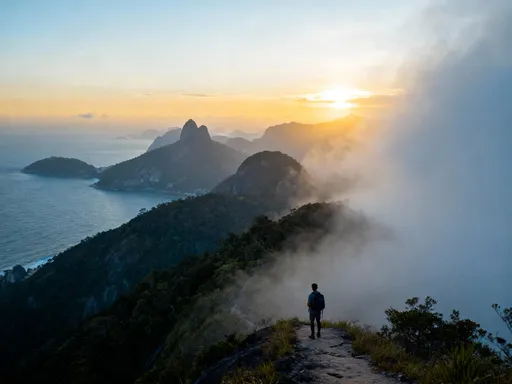
For those seeking a true adventure, Pedra da Gávea offers one of the most exhilarating hikes in South America. This massive rock formation, rising over 800 meters above sea level, dominates the skyline in the São Conrado neighborhood. Its name, which translates to “Lookout Rock,” is fitting—those who reach the summit are rewarded with one of the most breathtaking panoramas in Brazil. The view stretches from the southern beaches of Barra da Tijuca to the northern lagoons, with the endless blue of the Atlantic forming the horizon.
The hike itself is not for the faint of heart. Rated as difficult, the trail combines steep climbs, exposed ridgelines, and sections that require the use of hands. Along the way, hikers navigate iron rungs and cables bolted into the rock—remnants of early 20th-century mountaineering efforts. The so-called “Roman’s Nose” section is particularly thrilling, a narrow spine with dramatic drops on either side. While the path is well-established, it demands physical fitness, proper footwear, and a respect for the terrain. This is not a casual nature walk; it’s a mountaineering experience within city limits.
Because of the technical nature of the route, hiring a certified local guide is strongly advised. These guides are not only familiar with the safest paths but also share stories about the rock’s history, including early European explorers and indigenous legends tied to the peak. They carry first-aid kits and know emergency protocols, which adds a crucial layer of safety. Most guided groups start before sunrise to avoid the midday heat and complete the ascent in 4 to 6 hours round-trip.
The reward at the top is more than just a view—it’s a sense of accomplishment. From the summit, you can see the intricate mosaic of Rio: neighborhoods nestled in valleys, beaches curving like ribbons, and the endless green of the Tijuca Forest stretching into the distance. On clear days, you might even spot Ilha Grande, a protected island reserve off the coast. The silence at the peak, broken only by the wind, offers a rare moment of stillness in a city known for its energy. For many, this hike becomes the defining memory of their visit—a testament to Rio’s power to surprise and inspire.
Prainha & Grumari: Secret Beaches with Soul
West of Rio’s famous southern beaches lies a quieter, wilder coastline where the ocean meets pristine forest. Prainha and Grumari are two of the city’s best-kept secrets—beaches that feel untouched by time. Unlike the bustling boardwalks of Copacabana, these shores are surrounded by protected green areas, accessible only by winding roads that discourage mass tourism. The journey itself feels like an adventure, with each turn revealing deeper shades of blue and denser jungle cover.
Prainha, meaning “little beach,” is a favorite among surfers. Its consistent waves attract experienced riders, but the beach also offers calm spots for swimming and sunbathing. The surrounding hills are covered in native vegetation, and at low tide, rock pools emerge, perfect for exploring marine life. A small kiosk serves cold coconut water and grilled snacks, but there are no high-rise hotels or souvenir stands—just sand, sea, and sky. Because access is limited and parking is minimal, crowds remain manageable even on weekends.
Just a short drive further lies Grumari Beach, often described as Rio’s most beautiful. Longer and more secluded than Prainha, Grumari is flanked by forested bluffs and dunes. The water is exceptionally clear, and the sand is soft and golden. What sets Grumari apart is its sense of solitude. Even during peak season, it never feels overcrowded. Families spread out under umbrellas, dogs run freely (a rare sight on Rio’s urban beaches), and couples walk along the shore without distraction. The absence of commercial development enhances its charm—there are no beach chairs for rent, no loud music, just the rhythm of the waves.
Reaching these beaches requires preparation. Public transportation is limited, so most visitors come by car or organized tour. Parking is available but fills up quickly on sunny days, so arriving early is wise. The roads are paved but narrow, with sharp curves—driving cautiously is essential. Both beaches are within the protected environmental area of the Grumari Municipal Nature Park, meaning development is restricted to preserve the ecosystem. Visitors are encouraged to follow “leave no trace” principles: taking all trash with them and avoiding loud noise. For those willing to make the trip, the experience is transformative—a reminder that beauty thrives where nature is respected.
Sugarloaf Mountain Beyond the Tourist Trail
No symbol is more iconic to Rio than Sugarloaf Mountain, or Pão de Açúcar. Millions ride its cable cars each year, ascending from Urca to the 396-meter summit for sweeping views of the city. While the experience is undeniably spectacular, most visitors follow the same routine: arrive mid-morning, wait in long lines, and descend by mid-afternoon. But there’s a quieter, more magical way to experience Sugarloaf—one that reveals its true essence.
Going at sunrise or sunset transforms the journey. At dawn, the first light paints the sky in soft pinks and golds, illuminating the city as it slowly wakes up. The air is cool, the crowds are thin, and the cable cars move quickly. Photographers favor this time for the gentle lighting and dramatic shadows across Guanabara Bay. Sunset offers a different kind of magic—the city lights begin to flicker on, Christ the Redeemer glows in the distance, and the ocean turns deep indigo. Both times provide a more intimate connection to the landscape.
Many tourists don’t realize that the summit offers more than just photo ops. A network of short walking paths circles the top, allowing visitors to explore different vantage points. One trail leads to a secluded ledge that faces west, perfect for watching the sun dip below the horizon. Another offers a direct view of Morro da Urca, the first stop on the cable car route, with its rocky outcrops and clinging vegetation. These paths are often overlooked, yet they deepen the experience, turning a quick visit into a moment of reflection.
To avoid the busiest hours, aim to arrive right when the cable cars open at 8 a.m. or book a late slot after 4 p.m. Tickets can be purchased online to skip the ticket line. While the ride itself is safe and well-managed, it’s still wise to keep belongings secure and stay with the group if traveling solo. The entire experience—from the gentle sway of the cable car to the quiet moments at the top—captures Rio’s ability to blend grandeur with serenity. It’s not just a view; it’s a perspective.
Lagoa Rodrigo de Freitas: Urban Nature Done Right
Nestled between Ipanema and Leblon, Lagoa Rodrigo de Freitas is a masterpiece of urban planning and natural beauty. This scenic lagoon, shaped like a teardrop, is surrounded by a 7.5-kilometer paved path that draws runners, cyclists, and families every day. Unlike artificial lakes in other cities, Lagoa is a living ecosystem—home to herons, kingfishers, and even caimans in its quieter corners. Mangroves line parts of the shore, filtering water and providing habitat for fish and crustaceans. It’s a rare example of nature and city coexisting in harmony.
For locals, the Lagoa is more than a park—it’s a lifestyle. Early mornings see joggers in motion, dogs on leashes, and fitness groups doing yoga on the grass. On weekends, the road is closed to cars, turning the area into a car-free haven. Families rent tandem bikes, couples paddle in swan-shaped kayaks, and teenagers practice skateboarding near the fountains. Lakeside cafes serve fresh fruit juices, açaí bowls, and grilled cheese sandwiches, offering a taste of Rio’s healthy, outdoor-oriented culture.
One of the most peaceful ways to experience the Lagoa is by kayak or stand-up paddleboard. Rentals are available along the eastern shore, and gliding across the calm water offers a unique perspective of the city. From the middle of the lagoon, you can see the Dois Irmãos peaks in the distance, framed by apartment buildings with rooftop gardens. It’s a reminder that urban life doesn’t have to mean disconnection from nature.
What makes the Lagoa truly special is its accessibility. Unlike remote hikes or secret beaches, this space is open to everyone, every day. It doesn’t require special gear or long travel. Visitors who spend time here begin to understand how Cariocas maintain balance—how they thrive in a vibrant city while staying rooted in nature. To experience it like a local, come early, bring water, and take your time. Walk the full loop, stop for a snack, and watch the light change over the water. In a city full of grand gestures, the Lagoa is a quiet masterpiece.
Putting It All Together: Planning Your Nature-Focused Visit
Visiting Rio with a focus on nature doesn’t mean skipping the famous landmarks—it means reimagining them. You can still see Christ the Redeemer, but consider hiking part of the trail through Tijuca Forest to reach it. You can ride the Sugarloaf cable car, but choose sunrise for a more meaningful experience. The goal is depth over checklist tourism, connection over consumption. By prioritizing natural immersion, you gain not just photos, but a deeper understanding of Rio’s soul.
A well-balanced three-day itinerary might begin with Tijuca National Park on day one—explore Cachoeira do Barata in the morning, hike to Maynart’s Vista in the afternoon, and end with a sunset drink near Lagoa. Day two could be dedicated to the coast: start early for Prainha, surf or swim, have lunch at a beach kiosk, then continue to Grumari for a quiet afternoon. Return as the sun sets behind the hills. On day three, tackle Pedra da Gávea with a guide in the morning, rest in the afternoon, and finish with a peaceful paddle on Lagoa at dusk.
Throughout your visit, embrace the rhythm of the city. Rise early to avoid heat and crowds. Stay hydrated and wear sunscreen—Rio’s UV index is high year-round. Respect local customs: keep noise low in natural areas, avoid littering, and support small vendors. Many eco-tours and guided hikes are run by community organizations, so your spending supports conservation and local livelihoods.
Rio’s wild side is not an escape from the city—it is the city’s true face. Beyond the postcards and parties, the mountains, forests, and lagoons tell a quieter, more enduring story. They remind us that beauty doesn’t have to be tamed to be appreciated. In a world where nature is increasingly fragmented, Rio stands as a rare example of coexistence—where urban life and wilderness not only survive together but thrive. To visit Rio is to witness this balance. To explore its wild heart is to remember why we travel at all: to be moved, to be amazed, to feel alive.